 Destinations
 Videos
Day 4: the Causeway Coastal Route
The weather is superb this morning: not a cloud in the sky and glorious sunshine. It is a little chilly, but I am not complaining.
There is no need for a GPS: I simply follow the brown signs for the Causeway Coastal Route. Along the way, signs point to scenic routes. I try the first one, the Bay Brown Scenic Route, which takes me higher up and offers some lovely viewpoints. But at this rate, it could take me three days to reach my destination for the day: Letterkenny. I therefore decide to stop following these scenic detours and stay on the superb Causeway coastal road.
The Causeway Coastal Route
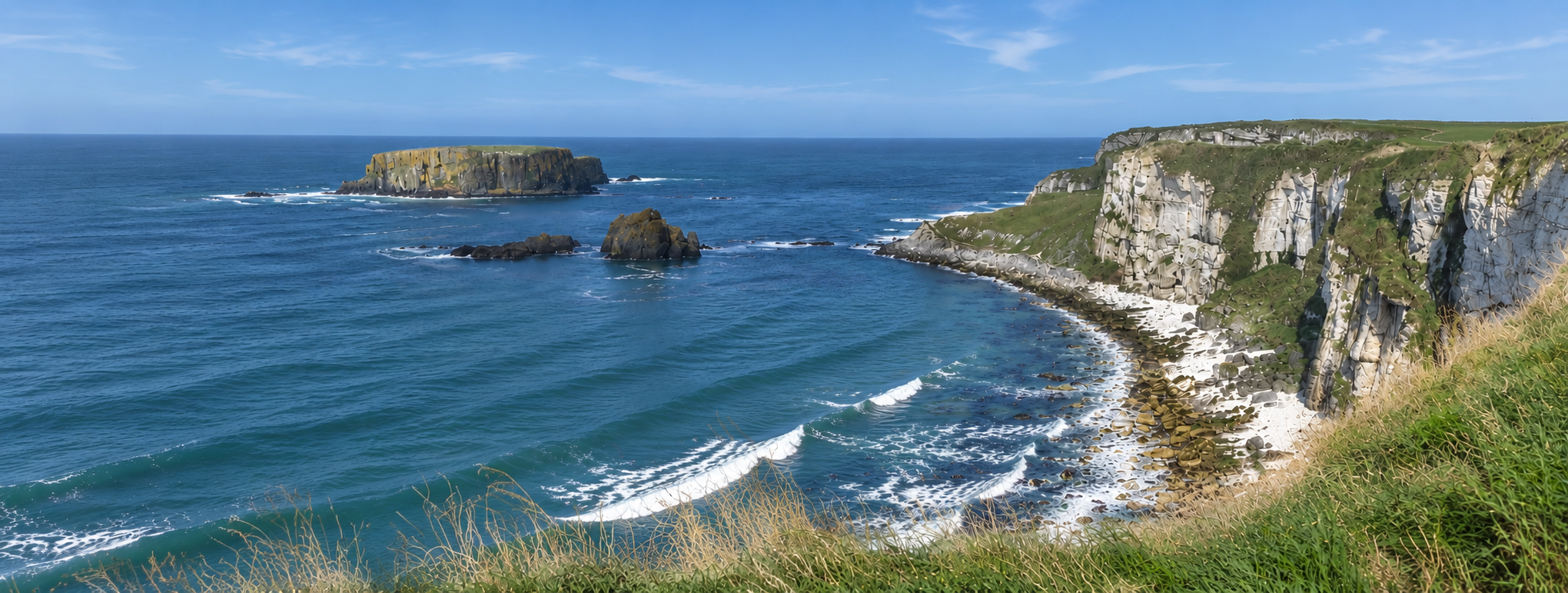
At first, I am a little frustrated because the road is coastal in name only: I cannot see the sea on my right. I pass through many pretty villages, but there is no sea view until beyond Larne. From there, the scenery becomes magnificent. The road runs past a succession of beautiful black-pebble beaches, lovely villages with houses overlooking the sea, cliffs and fields where numerous sheep graze… yes, let’s not forget that we are in Ireland. I particularly remember this beach on the Northern Irish coast.
The road is very pleasant, wide and easy to drive, nothing like the very narrow roads you can find in the south-west of Ireland, for example.
There are frequent car parks and small lay-bys where you can stop to take a photograph or simply admire the view.
At this time of year, in April, it is really pleasant because there is not much traffic on this very popular route.
Carrick-a-Rede
The two main stops planned for the day are the Carrick-a-Rede rope bridge and then the Giant’s Causeway.
I actually reach the Carrick-a-Rede area without realising it… As I enjoy the scenery along the road, I spot a car park on the right. I stop, and the view from the top of the cliff is superb. Far below, I can see a series of large rocks and a red spot that does not move. Using my binoculars, I realise that it is one of the rangers supervising the rope bridge crossing.
I set off again, following the road as it descends dramatically along the rock face before turning towards the car park, where only a few cars are parked. Given the number of spaces available, I can imagine what it must be like in summer. I am reassured to read that there is no waiting time to access the bridge. I suspect the situation is very different in summer.
It is a one-kilometre walk to reach the bridge, which allows a maximum of eight people at a time. Today, that is no problem.
It is quite an experience: the bridge bounces beneath my feet, which is impressive, especially as the drop below is clearly visible.
The Giant’s Causeway
I continue towards the Giant’s Causeway. The atmosphere changes here: there are many more visitors and the facilities are much larger. After Carrick-a-Rede, I discover the Giant’s Causeway from above. After all, I am now approaching one of Northern Ireland’s best-known sites, a UNESCO World Heritage Site. The contrast with the relative tranquillity of Carrick-a-Rede is striking. But that does not matter: I am above all eager to finally discover the famous Giant’s Causeway.
The red trail is marked as difficult on the way down, but it is actually very easy because the 162 steps are descended. On the way back, you should take the blue path. It is best not to do it the other way round, otherwise you will have to climb all 162 steps.
If you are a photographer, the hardest part is capturing the natural steps without tourists in the frame. But with a little patience, it can be done! I also take the time to photograph the basalt columns close up.
From the Giant’s Causeway to Londonderry
I had planned to visit Dunluce Castle, but in the end I skip this stop so that I can spend time in Londonderry, which I reach an hour later.
I park near the Peace Bridge and spend an hour walking around.
Goodbye Northern Ireland
Then it is on to Letterkenny. Goodbye Northern Ireland, hello Republic of Ireland. And, above all, goodbye pounds and miles, hello euros and the metric system.
I easily find a B&B, then go for a walk around the town centre and the town park.