 Destinations
 Videos
Day 1: Exploring Naples’ historic centre
On our first day in Naples, we set out to explore the old town and its historic neighbourhoods. Our accommodation is ideally located right in the heart of the old centre, just a short walk from several restaurants that we will have the chance to try, one after another, over the next few evenings.
We start our walk at the corner of Via Giovanni Maggiore Pignatelli and Via Benedetto Croce, keen to lose ourselves in the narrow streets of a city we are discovering for the first time.
Our first stop is Piazza San Domenico Maggiore, one of the landmark squares in the historic centre. We then continue to Via San Gregorio Armeno, famous for its many shops selling nativity-scene figurines. Alongside traditional characters, there are far more unusual creations. It is a lively, fascinating street, and it is hard not to stop and peer into the shop windows.
We take the opportunity to visit the Church of San Gregorio Armeno. The interior is well worth seeing, especially its magnificent, richly decorated ceiling.
We had also considered visiting underground Naples, but in the end we decide against it. The sun is shining, and we would rather make the most of the good weather than spend time underground. Perhaps next time!
Gradually, we leave the busiest streets behind and venture into narrower, less touristy lanes. Cobblestones, sometimes weathered façades and washing hanging from windows create a very different scene from the main thoroughfares. These are also the neighbourhoods where another side of Naples comes into view.
We reach the Donnaregina area, where we come across *Sheltering*, a sculpture by Canadian artist Timothy Schmalz. Known for his humanitarian-themed works, the artist has created a piece here that invites reflection. We take the opportunity to pause for a moment. We have already walked quite a distance, and the day is far from over!
We then make our way towards Piazza Dante, taking streets where tourists are much less common. The contrast with the historic centre is striking: some areas are less well maintained and cleanliness can leave something to be desired. But that is part of discovering a city too: looking beyond the busiest places and being willing to see all its sides.
After such a busy morning, we head back to the apartment for a little break. Lunch is simple and unpretentious: pasta with a tomato sauce we picked up along the way. A welcome pause before setting off to explore Naples again.
In the afternoon, we resume our sightseeing at the Chiesa del Gesù Nuovo, admiring in particular its striking stone façade. Photographing the streets of the historic centre is not always easy. They are often very narrow, there is little room to step back for a good perspective, and buildings quickly fall into shadow. Sometimes you have to search for just the right angle to capture the atmosphere.
We then decide to make our way up to Castel Sant’Elmo, perched high above Naples. It is a climb that has to be earned! The road rises gradually before giving way to seemingly endless flights of steps. And even at the end of October, the heat is still very noticeable.
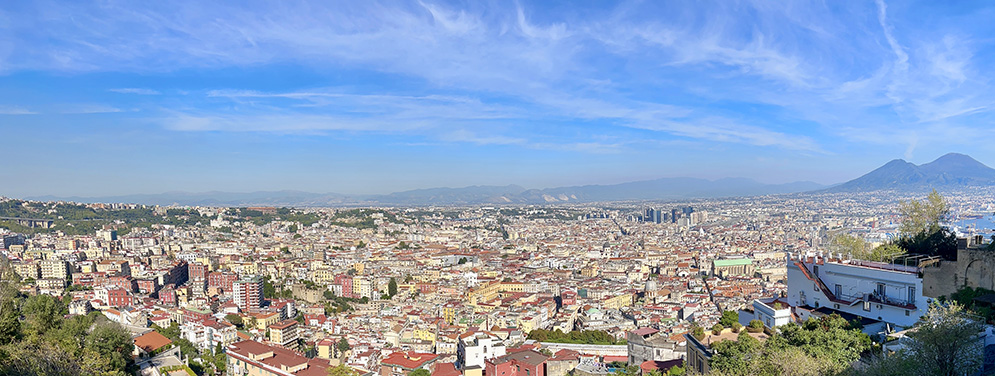
We take a few breaks at the various viewpoints along the way up. The effort is rewarded with superb panoramic views over Naples and its bay. From these vantage points, the city stretches as far as the eye can see, with Mount Vesuvius rising in the background. I take advantage of these stops to capture a few photos, particularly of these magnificent views across the city.
On the way back, we take a detour through the Spanish Quarter. It is impossible to miss Diego Maradona here! The famous Argentine footballer is everywhere: on walls, in murals and portraits, and in the many tributes dedicated to him. His presence has become an integral part of Naples’ popular identity. We stop for a drink before strolling back to our apartment.
What a day! We have covered a large part of the historic centre, discovered very different neighbourhoods and, above all, enjoyed magnificent views over the city. Plenty of walking, a few well-earned breaks and a wonderful first taste of Naples’ distinctive atmosphere.
Day 2: Pompeii: In the footsteps of a lost city
We leave our accommodation at around 8 am and walk to Naples Central Station. Our destination is Pompeii, which we reach in about 40 minutes aboard the Circumvesuviana train. The train is already quite crowded: seats are hard to come by, and we spend a good part of the journey standing!
Before long, Mount Vesuvius comes into view. Some passengers get off at Ercolano Scavi, probably to make their way to the volcano and climb to its summit. We continue on to Pompeii Scavi – Villa dei Misteri station. Just a few minutes' walk brings us to the entrance of the archaeological site. Having bought our tickets in advance, we can skip the queue – a great start to the day!
By setting off early, we are also lucky enough to arrive before the large tourist groups, particularly those arriving from cruise ships. The first 45 minutes are therefore relatively peaceful. We wander among the ruins of this ancient city, with Mount Vesuvius as a backdrop. It is hard not to imagine what the inhabitants went through on that day in 79 AD, when their everyday lives suddenly turned into a nightmare.
The eruption begins with an enormous column of ash and gas, followed by showers of pumice and lapilli raining down on the city and damaging its buildings. Then, as the hours pass, the volcano releases pyroclastic flows – terrifying currents of scorching gas and volcanic material that rush down its slopes at tremendous speed. For those who have not managed to escape, the chances of survival become virtually nil. Pompeii is gradually buried beneath layers of volcanic deposits.
As the morning goes on, more visitors arrive and the site becomes busier. Fortunately, it is large enough for people to move around without getting too much in one another’s way. The biggest crowds gather around the casts of the victims, often referred to simply as “the dead”.
These plaster casts were made by pouring plaster into cavities left in the hardened ash after the bodies had decomposed. Developed in the 19th century, the technique recreates the victims’ final positions with astonishing accuracy. Some details are deeply moving: tense faces, protective gestures, foetal positions… We are no longer simply looking at archaeological remains; we are confronted with human stories frozen in time for almost 2,000 years. It is deeply affecting, and feels like a journey into the past.
Another source of amazement is how remarkably well some of the wall paintings inside the houses have been preserved. After almost two millennia, their colours and details are still visible. It is hard to imagine these decorations surviving so many centuries beneath metres of volcanic material.
By around 11.30 am, a sandwich break is in order! Our legs are beginning to ask for a rest, and our stomachs are making themselves heard too.
After this break, however, getting going again proves a little harder. It is hot, fatigue is setting in and the site has become noticeably busier. Still, we have set ourselves a goal: to explore the entire site. So off we go again!
We continue to the area where several casts of victims are displayed alongside explanatory panels. A short, particularly informative film helps explain how the casts were made and how this technique preserved the impressions left by the bodies.
Exhausted but deeply impressed, we begin the journey back. We take a different route from the one we used earlier, allowing us to discover a few more interesting remains that we had not noticed before.
At around 3.30 pm, we catch the train back to Naples and head straight to our apartment. Our legs have certainly earned a little rest!
Pompeii is undoubtedly a must-see during a stay in Naples. The visit is fascinating, both for the wealth of archaeological remains and for the emotion stirred by this journey into the tragic past of an entire population. An experience that leaves a lasting impression.
Day 3: A few final discoveries in Naples
The forecast had predicted rain for our final day, which is why we had booked a visit to the Sansevero Chapel Museum. Unfortunately, there were no morning slots left, so we had to settle for a 2 pm visit.
In the morning, the rain does indeed arrive — and quite heavily! After two particularly strenuous days of walking, we decide to treat ourselves to a well-earned lie-in. In the end, that is no bad thing!
Towards the end of the morning, we take advantage of a break in the rain to visit the small Museum of Torture and the Inquisition. It is a disturbing visit, leaving us to wonder at the human imagination that went into devising ever more cruel instruments to inflict terrible suffering on others. It is hard not to be shocked by such sadism and brutality.
Then it is time to discover the famous Sansevero Chapel. And here comes a slight disappointment! Despite having a timed ticket, which is compulsory for entry, we still have to wait in the street. The reason is simple: the chapel is tiny and can only accommodate a limited number of visitors at a time.
Once inside, photography and video are not allowed. The chapel is indeed beautiful and richly decorated, but everyone’s attention is drawn to the famous Veiled Christ, the undisputed masterpiece. Visitors crowd around the sculpture, trying to take in every detail.
The most unpleasant part, however, is the attitude of the staff, who repeatedly urge us to keep moving and not to stand still for too long, so that space can be made for the next visitors. Under these conditions, it is difficult to make the most of the visit or take the time to admire the works.
All in all, it is certainly beautiful, but we leave with mixed feelings. In my view, the €12 per person admission fee is not really justified by the length and conditions of the visit. Does the chapel’s reputation match the experience on offer? Or has Sansevero simply become a victim of its own tourist success? Everyone can make up their own mind, but we leave feeling a little underwhelmed.
We then take the metro to Municipio station. As we emerge, we come face to face with Castel Nuovo, an impressive medieval fortress dominating the square. We continue towards Galleria Umberto I, where we take a short break. This magnificent shopping arcade, with its vast glass roof and elegant architecture, makes a striking contrast with the bustle of Naples’ streets.
We then admire the façade of the Palazzo Reale before taking Via Chiaia towards the seafront. The change of atmosphere is quite dramatic! After the lively, working-class lanes of old Naples, we find ourselves in a much more upmarket district, with designer shops and luxurious window displays. It really feels like a different world!
We had hoped to enjoy a walk through the large park by the sea, but it is closed because of the wind. Never mind: we can still enjoy a superb view of Castel dell’Ovo. The sun is beginning to sink, and its low, warm light beautifully illuminates the castle and its surroundings.
The same light also enhances the colourful façades of the San Ferdinando district, creating lovely contrasts and a few more opportunities to take out the camera.
This final walk has allowed us to discover another side of Naples. It is well worth venturing beyond the old town, with its lively lanes and popular atmosphere, to explore more elegant neighbourhoods opening onto the seafront. Naples is certainly much more than its historic centre!